Monday, June 14, 2010

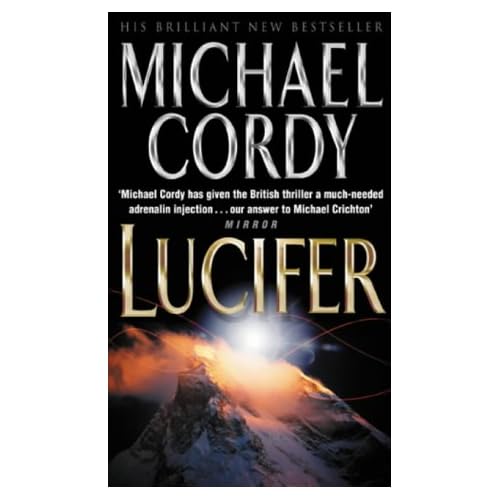
"Lucifer" by Michael Cordy


Dr Miles Fleming is a neuroscientist working on a device capable of reading human brainwaves, enabling paralyzed or even comatose subjects to communicate with the outside world. It all takes a turn for the weird when Flemings brother contacts him through the device, despite having been dead for six minutes. The sceptic and atheistic Fleming, while trying to find a reasonable, scientific explanation to the strange event, gets tangled up with a religious group who wants the device for their quest to prove the existence of an afterlife and ultimately, God.

Not being a huge fan of crime and conspiracy-fiction in general, I picked up Lucifer by Michael Cordy mostly due to the lack of anything else to read (I found two of Cordy's books in a pile of paperbacks my mum left me a while back) but also because of a bright red sticker on the cover saying in block letters :

”As good as Michael Crichton or your money back!”

Well, since the book was a few years old by then I wasn't really expecting a refund. What I also wasn't expecting was to be genuinely entertained by the story, and to my utter surprise I found myself not only finishing the book in record time, but even enjoying it so much I read the second of the books right after I finished the first. Despite a plot that reeks of Hollywood blockbusters and characters that are little more than bland stereotypes, Lucifer manages to present a scenario of plausible technology with some less plausible metaphysics and enough twists and thrills to keep one entertained throughout. Sure, its not very original and the focus is heavy on action and plot rather than characters and mood, but then again, this is not classical literature, but mainstream thriller, and as such, Lucifer does pretty well for itself.

Summary:

I like to think of Lucifer as a blend of James Bond and The Da Vinci code that presents readers with a easy yet entertaining read that manages to stand out of the crowd of mainstream thrillers by the smallest of margins.

And no, its not really better than Michael Crichton. Can I have my money back now?

6/10

Monday, April 19, 2010

Metro 2033 review


Metro 2033 by Dmitry Glukhovsky

Moscow in the year 2033, almost 20 years after a cataclysmic war that turned the world to rubble and nearly wiped mankind of the face of the planet. The few remaining inhabitants of the city have fled underground to the Moscow metro, seeking shelter from radiation and the mutants who now roam the city. Life on the surface before the war is a distant memory and no one truly knows how much of mankind has survived beyond the boundaries of Moscow.
Stations have turned into miniature city-states, many with their own politic agenda but most just places where people huddle together to survive and repel raiders and bandits.

At VDNKh, the northernmost station in the Metro, a new threat emerges, as something horrible seeks to enter the tunnels and prey on its inhabitants. A young orphan living in VDNKh, Artyom, must brave the tunnels and venture to the center of the Metro, the legendary Polis, to find help and bring warning of the encroaching darkness.
Along the way he is confronted by the best and, more frequently, the worst of a struggling mankind – Neo Nazis, religious fanatics, communist revolutionaries and depraved people doing anything to survive. Beyond the light of the stations lurks another kind of danger. Dark things snatching children in the night, mutant creatures from the surface preying on the weak and whispers in the dark that drive travelers insane. The odds are truly stacked against the inexperienced Artyom, yet the fate of his station and perhaps all of the Metro, rests heavily on his shoulders and at the same time, the fate of Artyom himself seems to be linked somehow to the mystery of the dark invaders.

In Metro 2033 Mr. Glukhovsky paints a depressing and disturbing picture of a post-war society struggling to hang on while beset by dangers, human and otherwise, on all sides. Life in the tunnels is usually short, miserable and more often than not ends in a violent death and the author does an excellent job of conveying this mood of hopelessness and fear to the reader, as well as maintaining a feeling of tension throughout most of the book.

The characters, especially Artyom himself, are for the most part well-written and believable. The author manages to communicate their motivations and feelings well, making them feel less like two-dimensional stereotypes and more like real people.
Story-wise the plot is a slow burner, with plenty of sidetracks, many of which we never get to see resolved. This is a daring but commendable move on the authors part, as he's populating his world with a lot of interesting elements that he's not afraid to leave unresolved to avoid bogging the story down or drawing it out to much. This also serves to keep the reader guessing until the very last page whats really going on and how it will end, and ultimately left me wanting to know more.

If I had to find something negative to say about Metro 2033, it would have to be the editing and language of the UK edition I read. With all due respect to the translator, the translation itself left something to be desired, especially in its choice of words and grammars, making it a bit hard to read in places and I found several typos and missing words. Overall this is a very minor complaint on such a marvelous piece of fiction!

Summary:

If you like post-apocalyptic settings and don't mind a bit of the supernatural mixed in, strap on your gas mask, load your rifle and give Metro 2033 a go. 

10 out of 10


Saturday, April 3, 2010

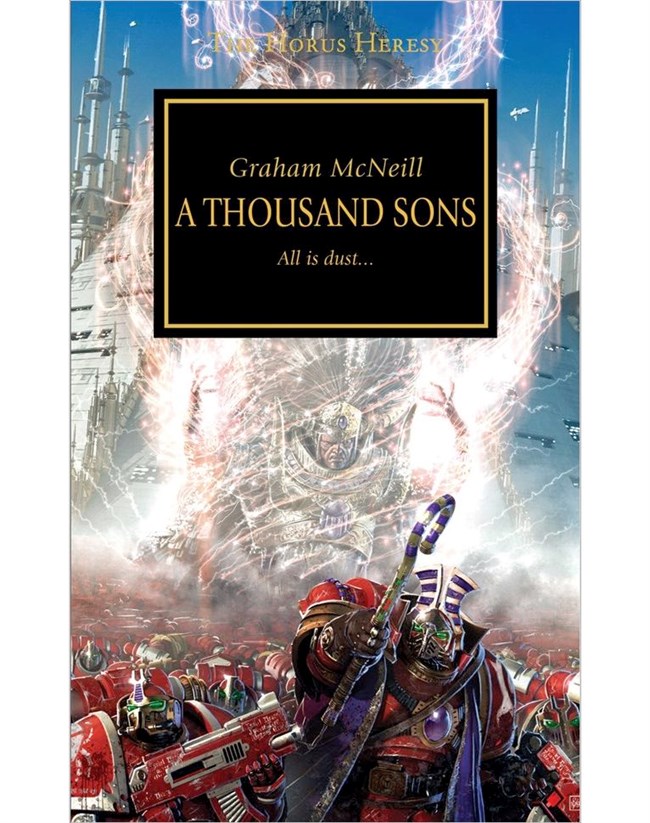
A Thousand Sons review


A Thousand Sons by Graham McNeill

This book is part of a series and as such not really recommended for newcomers to the series. It relies heavily on the reader having some previous knowledge of the setting and events of the previous books. If you haven't read any of the Horus Heresy novels before I recommend you start here.

The latest release in the Horus Heresy series of books from The Black Library, “A Thousand Sons” by  Graham McNeill (author of a number of Warhammer and Warhammer 40,000 novels, including the Ultramarines series and Storm of Iron), gives us a closer look at the Space Marines of the Thousand Sons legion and its founding father and primarch, Magnus the Red. 

We follow the legion on its crusade to reunite the Imperium of Man with her lost colonies and partake in some of the events that will define the role of the Thousand Sons in the Heresy.
After uncovering an ancient secret hidden beneath a great mountain made by aliens at the primitive planet of Aghoru the Thousand Sons join the Space Wolf legion and the Word Bearers in the assault on the fiercly independent world known by Imperials as “Shrike” due to the giant birds indigenous to the planet. There animosity ignites between the Sons and the Space Wolves, setting of a chain of events that will ultimately decide the role and fate of the Thousand Sons in the coming Heresy.

Having read some of Graham McNeill's previous work for The Black Library I picked up this book expecting more of the well written action, intrigue and suspense that got me hooked on the Ultramarines series, Storm of Iron and his previous Horus Heresy novels, and I must say, I was not disappointed!
Although the Space Marines and mortals in “A Thousand Sons” initially comes off as rather stereotypical (the extremely beautiful but non-sexual female remembrancer, the wise and patient Librarian and the hot-blooded and arrogant Space Marine Commander are all good examples), McNeill still manages to make them interesting and likeable, and even gives us a glimpse into the mind of Magnus the Red himself, portraying a primarch from a first hand perspective (something I believe few if any authors have dared try before).

The story itself is well paced and engaging, and I found it very hard to put the book down, always aching to find out what happens next and I rarely found it too predictable (well, as far as details go at least, most readers will be quite aware of how the over-arching story of the Heresy ends). While not as action-filled as might be expected from a novel about Space Marines, it more than makes up for it in intrigue and drama, and the tragedy of the Sons inevitable fate as the Imperium unravels and turns upon itself is quite simply gripping and what really makes this book shine.

Summary:

An almost essential read for fans of the Warhammer 40,000 setting. While the characters are not the most original or fleshed out, the drama and intrigue as well as the exploration of one of the Heresy's most iconic legions are more than enough to keep the reader hooked.
Mr. McNeill again proves that he really knows how to tell a balanced and intriguing story!
 
9 out of 10